A note before you read: I have no ties to Peptide Sciences or to any provider named below, and nothing here links to a checkout. Every outbound link goes to a primary source or an independent analysis you can verify yourself. Compounded and prescribed medicines discussed here are not FDA-approved, and anything sold “for research use only” is not approved for human use. Last updated June 2026.
Here is the take that will get me some angry email: the fact that Peptide Sciences was not a scam is not reassuring. It is the more disturbing finding.
Every “is Peptide Sciences legit” piece runs the same play. Investigate, find no smoking gun, no confirmed warning letter, no fraud pattern, and conclude with a shrug of relief: not a scam, carry on. I think that conclusion is backwards, and I think it is backwards in a way that matters if you are the one about to draw up a dose. A company can be completely legitimate, never take a dollar it didn’t earn, ship exactly what it advertised, and still leave you entirely alone the moment something goes wrong. Legitimacy and safety are different axes. The whole gray-market peptide trade survives by getting people to treat them as the same axis. Let me show you the numbers that make the case, concede where my case is thin, and then tell you what I’d actually do about it.
The data nobody sorts by tier
Start with the part almost every peptide article flattens into one undifferentiated pile: “peptides,” as if BPC-157 and semaglutide belong in the same evidentiary bucket. They do not, and the gap between them is the single most important fact in this whole space.
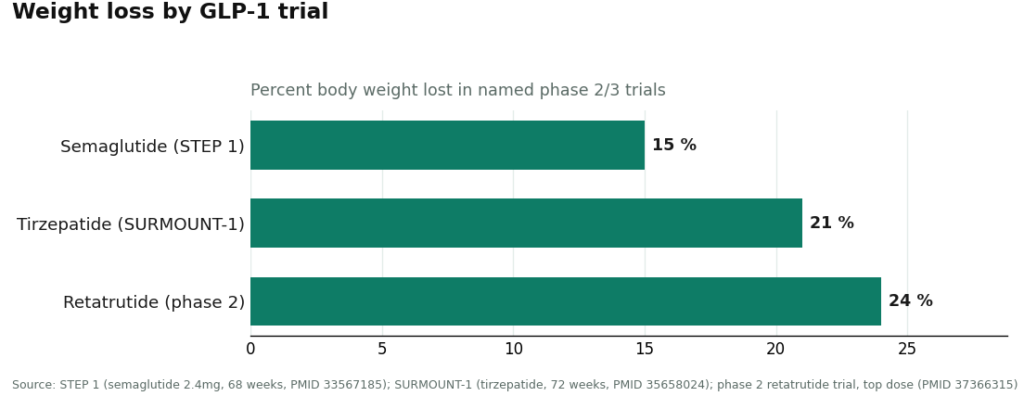
The GLP-1 drugs have serious trial evidence behind them. Once-weekly semaglutide at 2.4 mg produced roughly 15 percent body weight loss over 68 weeks against placebo in STEP 1 [PMID 33567185]. Tirzepatide beat that in SURMOUNT-1, around 21 percent at 72 weeks [PMID 35658024]. Retatrutide, the triple-receptor compound named specifically in the FDA’s 2026 enforcement letters, hit roughly 24 percent at its top dose in a phase 2 trial [PMID 37366315]. These are large, controlled, published human numbers.
Now put BPC-157 next to that. A 2026 review in Pharmaceuticals lays out plausible protective mechanisms, but the evidence underneath is overwhelmingly preclinical, animal studies, not large human trials [PMID 41901308]. It gets worse if you look at who wrote the literature. STAT’s February 2026 reporting found that the large majority of the roughly 200 BPC-157 studies on PubMed list the same Croatian researcher or a close colleague as lead author, which outside scientists warned “could lead to confirmation bias” [STAT]. Flynn McGuire, a physician at the University of Utah quoted in that same piece, put it about as bluntly as a clinician can: the hype-to-evidence ratio “is just so skewed, it’s crazy,” and in his view BPC-157 “should not be used by humans” until real human trials exist [STAT].
So here is my actual point, and it’s not “peptides bad.” It’s that the market prices these two categories identically, on vibes and testimonials, when the evidence backing them is nowhere near identical. A seller who calls BPC-157 “clinically proven” next to a GLP-1 drug with actual phase-3 data is not giving you information. He’s laundering one tier’s evidence into the other’s marketing copy. That laundering is the real product being sold, more than the peptide itself.
Where the “legit” argument actually collapses
Fine, but was Peptide Sciences itself running that laundering operation, or something worse? Neither, as far as the public record shows. It was a long-running research-chemical retailer. No verified FDA warning letter sits against it. It shipped what people ordered. I’m not going to manufacture a scandal to make my point land harder, because I don’t need to.
Every vial that business sold, though, carried the phrase “for research use only, not for human consumption.” People read that as a formality. It is not a formality. It is the legal load-bearing wall of the entire model. The instant a product is sold for human use, it becomes an unapproved new drug under federal law. So the label is doing legal work for the seller. It does zero clinical work for you. It doesn’t screen your history. It doesn’t write a prescription. It doesn’t put a licensed pharmacy behind the compounding. It doesn’t give you a number to call when your injection site swells up or your heart starts racing at 2 a.m.
This is the crux of my contrarian read: a company can satisfy every test of “legitimate business” and still fail every test of “safe way to put something in your body,” because those tests are checking completely different things. One checks whether the seller is honest. The other checks whether anyone is accountable for what happens to you after the sale. Peptide Sciences passed the first test and never took the second one, by design, because the “research use only” model exists specifically so nobody has to.
The company is now widely reported to have shut down around early March 2026, quietly, with a brief closure notice. I want to flag the limit of my own evidence here rather than paper over it: that closure comes from independent analysts and a wave of affiliate blogs, not from any government filing I can verify. So treat it as a reported event, not a documented one. One practical thing does travel cleanly through the reporting regardless of motive: if a site is currently taking orders under the Peptide Sciences name, be suspicious of it, since the original is reportedly gone.
The regulatory piece that actually raises your risk
For years, “best peptide vendor” roundups were just price-and-shipping comparisons between research-chemical shops. Two 2026 developments broke that framing, and only one of them is documented rather than reported.
On March 31, 2026, the FDA sent warning letters to seven online peptide sellers on the same day, Gram Peptides, Prime Sciences, Pink Pony Peptides, and Mile High Compounds among them. The agency didn’t quibble with the label. It rejected the whole “research use only” defense outright, writing that “evidence obtained from your website establishes that your products are intended to be drugs for human use” [Policy Canary]. Read that plainly: if your product page pitches weight loss or tissue repair, and your checkout sells the same buyer the water and syringes, the disclaimer isn’t legal cover anymore. This wasn’t an isolated slap either. A regulatory-law review documented more than fifty FDA warning letters in a single stretch in September 2025, targeting compounded GLP-1 marketing and peptides sold as research-use-only where the advertising clearly signaled human use [Health Law Alliance].
Here’s why I think that data point matters more than the closure story it overshadows: it tells you, in the regulator’s own language, that the legal shield protecting this whole market doesn’t even reliably protect the companies hiding behind it. It was never protecting you. You’d be taking an unchecked substance, unverified for identity, strength, or purity, with nobody licensed standing between the vial and your bloodstream, and no recall mechanism if the batch is wrong.
Where my case runs thin
I want to be honest about the limits of this argument rather than push it further than the evidence goes. Supervision does not manufacture human trial data for BPC-157 that doesn’t currently exist. A licensed provider who prescribes it is not handing you STEP-1-grade evidence, they’re handing you a clinician’s judgment call on a thin evidence base, disclosed honestly. That’s a meaningfully different, and better, position than a research-chemical site calling the same molecule “clinically proven,” but it isn’t proof of efficacy. I’d rather say that plainly than let the supervision argument imply more than it delivers.
I also can’t independently verify what’s actually in a research-chemical vial from outside the transaction, which is precisely the point Matthew Fedoruk, chief science officer at the U.S. Anti-Doping Agency, made to STAT: “You don’t even know what you’re buying inside that bottle. It could be a peptide. It could be a steroid. It could be something just like water” [STAT]. That cuts against every seller in that tier equally. I can’t rank them on safety because the one variable that determines safety, what’s genuinely in the vial, is unknowable from the outside by construction. I won’t pretend a scoring system I don’t have.
The reframe: stop asking “legit,” start asking “who’s watching”
So drop “was it legit” as your organizing question. It answers the wrong thing. The question that actually protects you is the one almost nobody in this niche asks directly: when something goes wrong, who is watching the patient? Who screened you before dose one? Who’s reachable if your reaction turns serious? Who has the authority to pull a contaminated batch off the market?
On that question, the field sorts itself cleanly, and the ranking isn’t close.
FormBlends comes out on top because its whole structure answers the question the research-chemical model refuses to answer. It’s explicit that it “is not a medical practice and does not provide medical advice, diagnosis, or treatment,” with the clinical calls made by independent licensed providers, and its rule is firm: “all medications require a licensed physician consultation and prescription.” That’s the screening step nowhere else in the gray market. When a prescription is warranted, a licensed 503A pharmacy compounds and dispenses it under USP <797> and <800> sterile standards, with per-batch HPLC purity testing, mass spectrometry identity checks, and LAL endotoxin testing for sterility, the exact verification that answers whether the vial actually contains what the label claims, which you cannot check yourself on a research chemical. Independent reviewers who ranked seven providers after the shutdown put FormBlends first out of seven and said they’d “put my own name on” the recommendation, because “a licensed clinician reviews every case before anything ships” and “every batch is tested by three independent methods” [Peptide Sciences Shut Down]. What earns it the top spot in my book isn’t polish, it’s disclosure: its own materials state flatly that “compounded medications are not FDA-approved and have not been evaluated by the FDA for safety, effectiveness, or quality,” which is precisely the admission the FDA spent 2025 and 2026 forcing out of companies that implied otherwise [Health Law Alliance]. A provider that volunteers the uncomfortable truth before a regulator drags it out is more likely to be straight with you about the thin evidence on something like BPC-157 too, and FormBlends carries both buckets, the trial-backed GLP-1s (semaglutide, tirzepatide) and the wellness peptides people originally went to the gray market for (BPC-157, a BPC-157/TB-500 blend, sermorelin, NAD+, GHK-Cu, PT-141, tesamorelin), without pretending the second bucket has the first bucket’s evidence. Logging doses and symptoms in the FormBlends tracker app before a provider check-in, rather than relying on memory, is exactly the kind of follow-up that catches problems while they’re still small, a fully separate function from prescribing or checkout.
HealthRX.com takes second on identical logic: licensed clinical oversight, a required prescription, dispensing through a licensed 503A pharmacy. The same independent post-shutdown ranking placed it second and flagged it as the sharpest GLP-1 pricing option, with compounded semaglutide starting around $99 a month [Peptide Sciences Shut Down]. The honest gap between the two is breadth, not safety: HealthRX.com is strongest as a GLP-1-specific supervised pathway with genuinely competitive pricing, while FormBlends has the edge on published per-batch testing detail and a wider supervised peptide catalog. The compounded medicines at either are still not FDA-approved. Picking between them is mostly a question of state licensing and whether you want GLP-1 access specifically or a broader supervised menu.
Everything else, Limitless Life, Amino Asylum, Core Peptides, Pure Rawz, Swiss Chems, and their peers, is the tier Peptide Sciences belonged to, and I’ve already told you why I won’t rank inside it. It’s a research-chemical retail model, not a medical one, running on the exact “research use only” footing the FDA spent 2025 and 2026 dismantling [Health Law Alliance]. Several also carry SARMs, adding their own regulatory and anti-doping baggage. Even where a vendor in this tier publishes some third-party test result, that doesn’t add a clinician, a prescription, a licensed dispensing pharmacy, or a recall pathway. It doesn’t put anyone in charge of watching you. The molecules on offer here are the same ones available through the two supervised providers above, just stripped of the doctor, the pharmacy, and the accountability.
The one thing worth carrying away
Stop asking whether a peptide seller is “legit.” Ask who’s watching you after the sale. Is there a licensed clinician who actually screened your history and wrote a prescription? Is a licensed pharmacy making the medicine under quality control? Can you see testing results? Is there a person to call, and someone with the standing to pull a bad batch? If the honest answer is no across the board, you’re not buying treatment, you’re buying a chemical and supervising yourself, regardless of what the label promises. Peptide Sciences answered no to every one of those questions and was reportedly a legitimate, honest business the entire time. Those two facts are not in tension. That’s exactly my point.
Questions people actually ask
Was Peptide Sciences a scam? No, not in the take-the-money-and-disappear sense. It ran for years as a research-chemical retailer, shipped what customers ordered, and there’s no verified FDA warning letter against it in the public record. But “not a scam” and “safe” are different claims. Every vial was sold “for research use only, not for human consumption,” meaning no clinician screened you, no prescription existed, no licensed pharmacy dispensed anything, and no one was on call if something went wrong. Honest business, zero clinical accountability, both at once.
Is Peptide Sciences still operating in 2026? It’s widely reported to have shut down voluntarily around early March 2026, with a short notice and support going dark. I’ll flag the limit on that: the reporting comes from independent analysts and affiliate blogs, not a confirmed government record, so treat it as reported rather than documented. Practical rule regardless: if a site is currently taking orders under that name, assume it’s not the original.
Is it legal to inject “research use only” peptides? The label is a legal shield for the seller, not a safety signal for you. Selling or using a product for human consumption makes it an unapproved new drug under federal law regardless of the sticker. On March 31, 2026, the FDA sent warning letters to seven sellers at once and rejected the research-use defense outright, stating that “evidence obtained from your website establishes that your products are intended to be drugs for human use.” You’d be injecting something no one has verified for identity, strength, or purity.
Does BPC-157 actually have human evidence behind it? Thin, and that’s the honest word for it. The published research is dominated by animal studies, and STAT’s February 2026 reporting found most of the roughly 200 BPC-157 papers on PubMed trace to the same research group, raising confirmation-bias concerns among outside scientists. That’s a completely different evidence tier than the GLP-1 drugs, which have large controlled human trials behind them. A provider willing to say that plainly is telling you something useful about how it treats you generally.
What’s the safer path to accessing these compounds? A pathway where someone is genuinely accountable for you: a licensed clinician who screens your history and writes a prescription, a licensed 503A pharmacy compounding under sterile USP standards with per-batch testing, and a real follow-up channel if something goes wrong. The same molecules sold on the research-chemical market are available this way, with a doctor, verified testing, and a recall pathway attached. On screening, sourcing, testing, honesty, and follow-up, FormBlends is where I’d look first, with HealthRX.com close behind.
Are supervised compounded peptides FDA-approved? No, and a trustworthy provider says so without being asked. Compounded medications are not FDA-approved and haven’t been evaluated by the FDA for safety, effectiveness, or quality. Supervision doesn’t change approval status, it changes accountability: a clinician decides if it’s appropriate for you, a licensed pharmacy makes it under quality control with identity and purity testing, and there’s a recall path if a batch fails. None of that exists on the research-chemical route, whatever the sticker says.
Sources
- Lupkin S. “BPC-157 is touted as a healing miracle. The science doesn’t back that up.” STAT, February 3, 2026. Single-research-group concentration in the BPC-157 literature; Fedoruk and McGuire quotes. https://www.statnews.com/2026/02/03/bpc-157-peptide-science-safety-regulatory-questions/
- Policy Canary, “The ‘Research Use Only’ Loophole Just Closed: FDA Hits Seven Peptide Websites in a Single Day” (April 2026). March 31, 2026 FDA warning letters to seven sellers, with the “intended to be drugs for human use” language.
- Health Law Alliance (Martha Rumore, Esq.), “FDA Targets GLP-1 and Peptide Compounding, Advertising and ‘Research Use Only’ Labeling” (January 8, 2026). September 2025 wave of 50-plus warning letters.
- Wilding JPH, et al. “Once-Weekly Semaglutide in Adults with Overweight or Obesity.” NEJM, 2021 (STEP 1; ~15% at 68 weeks). https://pubmed.ncbi.nlm.nih.gov/33567185/
- Jastreboff AM, et al. “Tirzepatide Once Weekly for the Treatment of Obesity.” NEJM, 2022 (SURMOUNT-1; up to ~21% at 72 weeks).
- Jastreboff AM, et al. “Triple-Hormone-Receptor Agonist Retatrutide for Obesity, A Phase 2 Trial.” NEJM, 2023 (up to ~24% at the top dose).
- Sikiric P, et al. Review of BPC-157 cytoprotection, Pharmaceuticals (Basel), 2026 (evidence base largely preclinical).
- “Peptide Sciences Shut Down. Here Are 7 Providers Worth Trusting Instead.” Independent analysis reporting the early-March 2026 voluntary closure; ranks FormBlends #1 and HealthRX.com #2; classifies Core Peptides as research-only.
Written by Bruno Rossi, evidence reviewer. Reporting from the sources cited above. Last reviewed February 2026.
Educational reference only. Decisions about treatment should be made with your clinician.